What Is Hermes Agent?
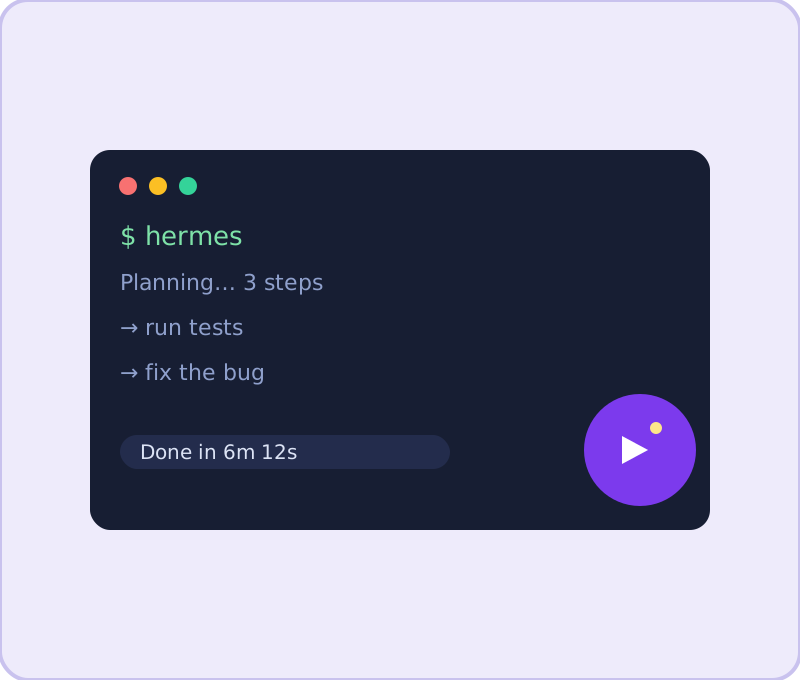
Hermes Agent is an open-source AI agent from Nous Research that runs in your terminal, your messaging apps, and your IDE. Unlike a chatbot that can only talk, Hermes uses tool calling to actually do things on your computer: run commands, edit files, search the web, schedule jobs, and carry a task from start to finish on its own.
| A chatbot… | An agent… |
|---|---|
| Answers your question | Completes the task the question was really about |
| Gives you a snippet to copy | Runs it, watches the result, fixes what breaks |
| Forgets you between chats | Remembers your setup, preferences and past lessons |
| Sits in one web page | Lives in your terminal, IDE and chat apps |
A chatbot answers; an agent acts
If you have used ChatGPT or Claude, you know the pattern: you ask, it answers, you copy the result somewhere and do the work yourself. Hermes Agent collapses that loop. Ask it to fix a failing test, and it will read the code, run the test, edit the file, and run the test again — reporting back when it is done. Ask it to research a topic and write a summary to a file, and the file will simply be there. It belongs to the same category as Claude Code, OpenAI Codex and OpenClaw: autonomous coding and task-execution agents. The difference is what it connects to — and that it works with any model provider, not one company's.
The four traits that set it apart
1. It learns skills. When Hermes solves a hard problem or gets corrected by you, it can save the working procedure as a reusable skill document. Next session, that skill loads automatically — the agent literally gets better at your tasks and your machine over time. Our skills guide shows the whole loop with recipes.
2. It remembers you. Hermes keeps persistent memory across sessions: who you are, your preferences, your environment, lessons learned. Pluggable backends (built-in, Honcho, Mem0 and more) let you choose how memory works — see the memory guide.
3. It lives where you chat. The same agent can run behind a gateway connected to Telegram, Discord, Slack, WhatsApp, Signal, Email and a dozen other platforms, with full tool access — not a stripped-down chat puppet. That is the gateway.
4. It is provider-agnostic. Hermes works with 20+ LLM providers — OpenRouter, Anthropic, OpenAI, DeepSeek, local models and more — and you can swap models mid-workflow without changing anything else. Credential pools even rotate across several API credentials automatically. Details in the providers guide.
What people actually use it for
Software development is the headline use — fixing bugs, running test suites, refactoring with git worktrees for isolation. But the same machinery serves research (multi-source summaries written to files), system administration (cron-scheduled maintenance jobs), data analysis, content creation, and home automation. Anything that benefits from an agent with persistent context and full system access is fair game.
License and cost
Hermes Agent is MIT-licensed open source. The agent itself is free; your cost is model usage on whatever provider you connect. That can be a few dollars of API credit, a subscription login you already have, or a free tier — you decide per project, and you can change your mind later without reinstalling anything.
Frequently asked questions
Is Hermes Agent free?
Hermes Agent itself is open source under the MIT license and free to install. You bring your own model access — a paid API credential from a provider such as OpenRouter or Anthropic, a subscription login such as Nous Portal, or a free local setup.
Who makes Hermes Agent?
Nous Research, the AI research company behind the Hermes model family. The project lives on GitHub at NousResearch/hermes-agent.
Does Hermes Agent run on Windows?
Yes. It runs natively on Windows terminals including PowerShell, cmd and git-bash, and on Windows via WSL. A handful of Windows-specific quirks are covered in our troubleshooting guide.