Hermes vs Claude Code vs Codex
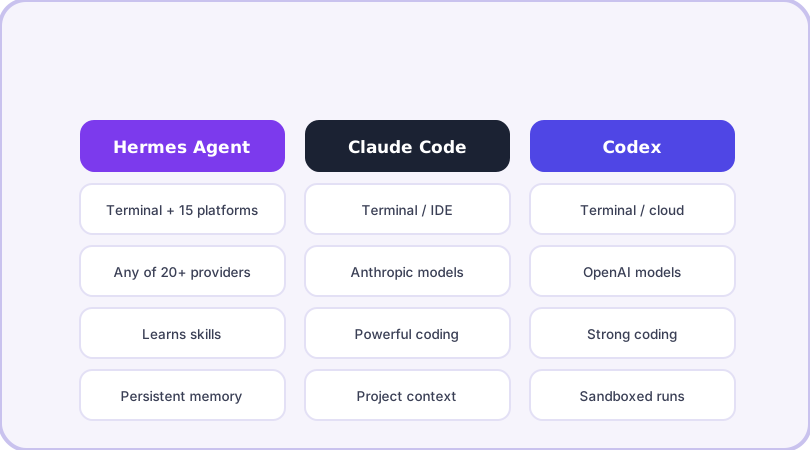
Hermes Agent, Claude Code and OpenAI Codex all live in your terminal and all finish real tasks. The honest differences are in scope, model freedom, and how much the agent carries between sessions.
The short version
Choose Claude Code if your entire day is coding inside one ecosystem, you want the most polished IDE-adjacent experience, and you are happy on Anthropic models. Choose Codex for the OpenAI equivalent: strong coding with cloud sandboxes. Choose Hermes when your ambitions go past the editor: one agent that codes and answers in WhatsApp at midnight and runs your nightly report and remembers your preferences — on whichever model you fancy this month.
Side by side
| Dimension | Hermes Agent | Claude Code | OpenAI Codex |
|---|---|---|---|
| Makers | Nous Research (open source, MIT) | Anthropic | OpenAI |
| Models | 20+ providers, swappable; credential pools | Anthropic models | OpenAI models |
| Surfaces | Terminal + 15 chat platforms + IDE (ACP) + WebUI | Terminal / IDE | Terminal / cloud |
| Learns skills | Yes — saves reusable procedures, hub + taps | Project config files | Project config files |
| Persistent memory | Yes — profile, lessons, pluggable backends | Within project context | Within project context |
| Scheduled jobs | Yes — built-in cron with multi-platform delivery | No (bring your own scheduler) | No |
| Parallel isolation | Git worktree mode (-w) | Worktrees supported | Cloud sandboxes |
| Profiles | Multiple isolated instances on one machine | — | — |
What "personal agent" actually buys you
Coding agents answer to the editor. Hermes answers to you: the same instance that refactors your library also watches a webhook, posts the build result to Discord, files a morning summary in Telegram, and recalls from memory that you prefer concise diffs. None of those jobs is coding, and none of them re-explains itself every morning — skills and memory carry the context.
The honest trade-offs
Focus has value: Claude Code's coding experience is extremely refined, and if that is 100% of your use, Hermes's breadth buys you little. Hermes also asks slightly more of you at setup — provider choice, optional gateway, optional backends — in exchange for a tool that fits more of your life. The upside of open source: five minutes to try it, and zero lock-in if you go back.
A practical note from real use: they coexist fine. Plenty of people keep a coding agent inside the IDE for the tight loop and Hermes as the always-on layer for everything with a schedule, a chat window, or a memory attached. If that split describes you, neither tool is wrong — the mistake is forcing one tool to be both.
Frequently asked questions
Is Hermes Agent better than Claude Code?
Different tools. Claude Code is a focused, polished coding agent deeply integrated with Anthropic models and IDE workflows. Hermes is a broader personal-agent platform: coding plus messaging apps, scheduled jobs, memory and skills, across 20+ providers. Many people run both.
Can they use the same models?
Claude Code uses Anthropic models; Codex uses OpenAI models. Hermes works with either — plus OpenRouter, DeepSeek, local models and more — so you can pick per task.
Does Hermes replace my IDE assistant?
It complements it. IDE assistants excel at in-editor suggestions; Hermes takes whole tasks — implement, test, commit — and can run them from a chat app or a cron job while you do something else.